How ChatGPT Actually Works: A Complete, Plain-English Breakdown
If you’ve used ChatGPT even once, you’ve probably had that slightly unsettling moment where it answers a tricky question, fixes your code, or writes a birthday poem in the exact tone you asked for and free ai tools for content writing— and you think, wait, how does it actually know how to do that?
You’re not alone. Millions of people use ChatGPT every single day, yet very few actually understand what’s happening between the moment they hit “Enter” and the moment words start appearing on the screen. Most explanations either oversimplify it into “it’s just autocomplete” (which is misleading) or drown you in technical jargon about transformers, gradients, and attention heads (which is exhausting).
This article sits in the middle. By the end, you’ll understand exactly how ChatGPT is built, how it’s trained, and what really happens inside it when you type a message — without needing a computer science degree to follow along.
What ChatGPT Actually Is
Let’s start with the basics. ChatGPT is a large language model, or LLM, built by OpenAI. At its core, it’s a very large mathematical system trained to do one specific thing extremely well: predict what word (or piece of a word) should come next in a sequence of text.
That’s it. That’s the entire foundational task. It sounds almost too simple to explain something as capable as ChatGPT, but the magic isn’t in the task itself — it’s in the scale, the training process, and the layers of refinement applied on top of that simple foundation.
Think of it like this: if you read millions of books, articles, conversations, and websites, you’d start to notice patterns. You’d know that “peanut butter and ___” is very likely followed by “jelly,” that a formal email usually ends with “Best regards,” and that a Python function definition needs a colon at the end. ChatGPT has effectively done this, except at a scale no human could ever achieve, across a huge portion of publicly available text.
The Foundation: Neural Networks and Transformers
Underneath ChatGPT is something called a neural network — a system loosely inspired by how neurons in the human brain connect and pass signals to each other. A neural network is made of layers of artificial “neurons,” each holding a numerical value. These layers are connected by millions (in ChatGPT’s case, billions) of adjustable parameters, sometimes called weights.
During training, these weights are adjusted over and over again until the network gets better at its task. It’s a bit like tuning thousands of dials simultaneously until the output sounds right.
Specifically, ChatGPT is built on an architecture called the Transformer, introduced by Google researchers in 2017 in a paper aptly titled “Attention Is All You Need.” The Transformer changed everything in the world of natural language processing because of one key innovation: the attention mechanism.
Before Transformers, language models processed text word by word, in strict order, which made it hard for them to remember context from earlier in a sentence or paragraph. The attention mechanism solved this by letting the model look at all the words in a passage at once and figure out which ones matter most to each other — regardless of how far apart they are in the text.
For example, in the sentence “The trophy didn’t fit in the suitcase because it was too big,” the word “it” could refer to either the trophy or the suitcase. A human understands instantly that “it” refers to the trophy. The attention mechanism allows the model to make that same connection by weighing the relationship between “it” and every other word in the sentence, and assigning more importance to the ones that are contextually relevant.
Step One: Turning Words Into Numbers
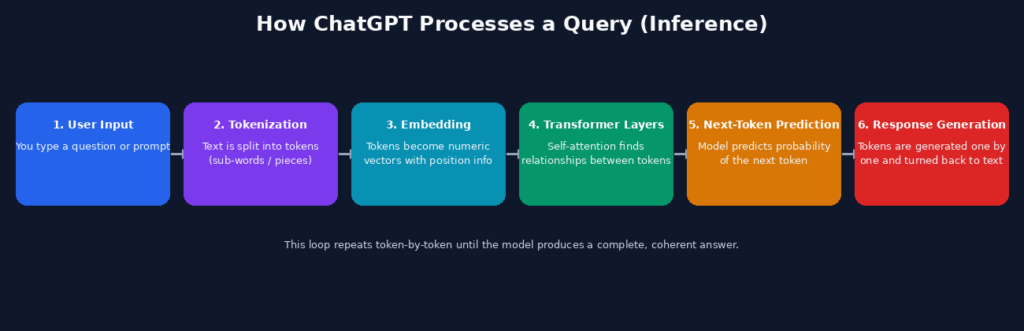
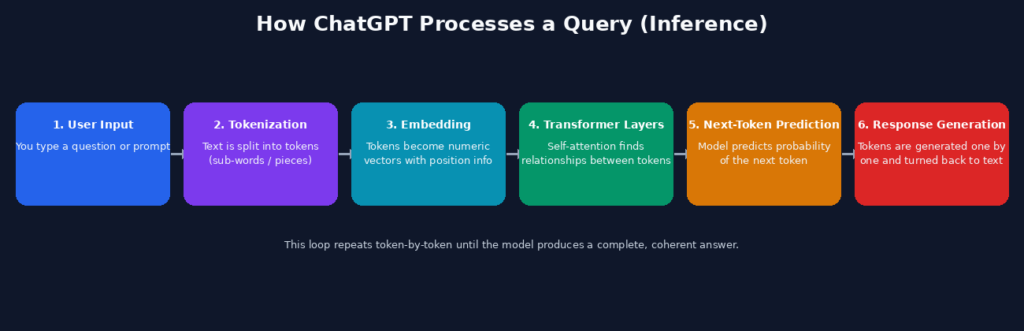
Computers don’t understand words the way we do — they understand numbers. So before ChatGPT can process anything you type, your text has to be converted into a numerical format. This happens in two steps.
Tokenization. Your sentence is broken down into smaller chunks called tokens. A token might be a whole word, part of a word, or even a single punctuation mark. For instance, the word “unbelievable” might be split into “un,” “believ,” and “able.” This approach lets the model handle rare words, typos, and even multiple languages without needing a separate dictionary entry for every possible word.
Embedding. Each token is then converted into a vector — a long list of numbers that represents its meaning in a mathematical space. Words with similar meanings end up with similar vectors. “King” and “queen” would be close to each other in this space, and interestingly, the relationship between “king” and “queen” tends to mirror the relationship between “man” and “woman,” because the model has learned these patterns purely from exposure to text.
On top of this, the model adds positional information to each token, so it knows not just what the words are, but the order they appear in. Without this, “the dog bit the man” and “the man bit the dog” would look identical to the model, which would obviously be a problem.
Step Two: The Transformer Layers Go to Work
Once your input is converted into these numerical vectors, it passes through dozens of stacked Transformer layers — the deeper, more advanced versions of ChatGPT can have well over a hundred of these layers.
Each layer does two main things:
- Self-attention — the model compares every token to every other token in the input and calculates how much “attention” each one should pay to the others. This is how the model figures out grammar, context, tone, references, and relationships between ideas.
- Feed-forward processing — after attention has been calculated, each token’s representation passes through additional mathematical transformations that refine and enrich its meaning further.
This process repeats layer after layer, with each layer building a progressively more sophisticated understanding of the text. Early layers might pick up on basic grammar and word relationships. Deeper layers start to capture more abstract concepts — sentiment, intent, logical structure, even humor or sarcasm.
By the time your input has passed through all the layers, the model has built an incredibly rich internal representation of what you actually mean, not just the words you used.
Step Three: Predicting the Next Word
Here’s where the actual “generation” happens. After processing your input, the model produces a probability distribution over its entire vocabulary — essentially a ranked list of every possible next token, along with how likely each one is to come next, based on everything the model has learned.
Let’s say you typed “The capital of France is.” The model might calculate that “Paris” has a 92% probability of being the next token, “the” has a 2% probability, and thousands of other tokens split the remaining probability between them.
The model then selects a token — usually the highest-probability one, though a bit of controlled randomness is often introduced to make responses feel more natural and less robotic. That newly generated token is added to the sequence, and the entire process repeats: the updated sequence (your original input plus the new word) is fed back through the model to predict the next token, and the next, and the next.
This is why ChatGPT appears to “type” its answer gradually — it’s generating one token at a time, each one informed by everything that came before it, including its own previous outputs. This loop continues until the model produces a special “stop” token, signaling that the response is complete, or until it hits a maximum length limit.
But Wait — How Does It Know What to Say?
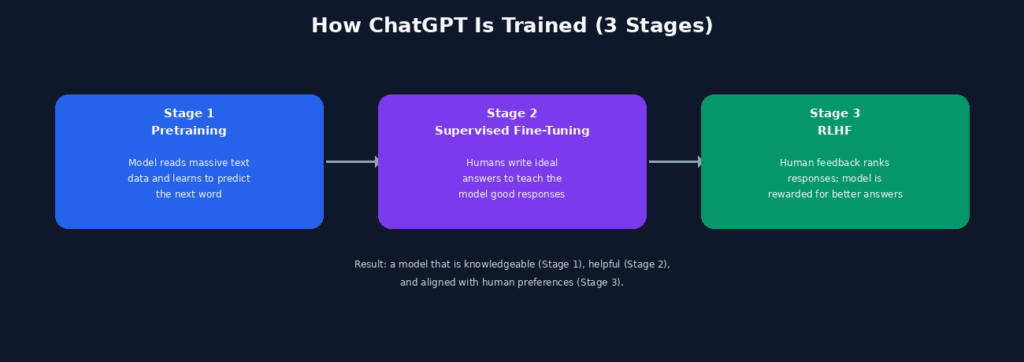
This next-token prediction mechanism explains how ChatGPT generates text, but it doesn’t fully explain why its answers are so often accurate, helpful, and appropriately structured. That comes down to training — and training happens in three major stages.
Stage One: Pretraining
This is where the model learns language itself. During pretraining, the model is fed an enormous amount of text — books, articles, websites, forums, and other written material — and its only job is to predict the next word over and over again, billions upon billions of times.
Through sheer repetition and scale, the model gradually absorbs grammar, facts, reasoning patterns, writing styles, and a broad understanding of the world as it’s represented in text. This stage requires massive computing power and can take weeks or months, running on thousands of specialized processors simultaneously.
At the end of pretraining, the model is knowledgeable, but not necessarily helpful or safe. It can complete text convincingly, but it hasn’t yet learned how to behave like a helpful assistant, follow instructions reliably, or avoid generating harmful content. That’s what the next two stages are for.
Stage Two: Supervised Fine-Tuning
In this stage, human trainers write high-quality example conversations — a prompt, followed by an ideal response. The model is then trained on these examples, learning to imitate the style, structure, and helpfulness demonstrated in them.
This is where the model starts to feel like an assistant rather than just a text predictor. It learns to follow instructions, answer questions directly, format responses clearly, and adopt a more conversational tone.
Stage Three: Reinforcement Learning From Human Feedback (RLHF)
This is arguably the most important stage for making ChatGPT feel genuinely useful and safe to interact with. Here’s how it works: the model generates multiple possible responses to the same prompt, and human reviewers rank them from best to worst based on qualities like helpfulness, accuracy, and safety.
These rankings are used to train a separate “reward model,” which learns to predict how a human would rate any given response. The original language model is then fine-tuned using reinforcement learning, essentially being nudged, through thousands of iterations, to produce responses that the reward model predicts humans will prefer.
This is how the model learns subtler behaviors — being appropriately cautious with sensitive topics, admitting uncertainty instead of confidently making things up, refusing harmful requests, and generally aligning its behavior with human expectations and values.

Context Windows: ChatGPT’s Working Memory
One concept that trips people up is how ChatGPT “remembers” a conversation. It doesn’t have memory in the way humans do. Instead, every time you send a message, the model re-reads the entire conversation so far — your previous messages and its previous responses — as part of its input. This full conversation history is called the context window.
Each model version has a maximum context window size, measured in tokens. If a conversation grows longer than that limit, the earliest parts of the conversation start to fall outside the window and are effectively “forgotten” unless a summarization or memory system is being used behind the scenes. This is why ChatGPT can sometimes lose track of something you mentioned much earlier in a long conversation — it’s not being careless, it’s simply working within a fixed-size window of visible text.
Some newer versions of ChatGPT also include a separate memory feature, where certain facts you share can be explicitly stored and recalled across different conversations, but this is a distinct system from the context window itself.
Why ChatGPT Sometimes Gets Things Wrong
Understanding how ChatGPT works also explains its limitations. Because the model is fundamentally predicting statistically likely text rather than looking up verified facts in a database, it can produce confident-sounding but incorrect information. This is often called “hallucination.”
It happens because the model doesn’t have a built-in mechanism to verify truth — it’s generating what’s statistically probable based on patterns learned during training. If a topic is obscure, ambiguous, or wasn’t well represented in the training data, the model may still generate a fluent, convincing-sounding answer that happens to be wrong.
This is also why more recent versions of ChatGPT are often connected to tools like web search, code execution, and file analysis — these give the model a way to pull in real, verifiable information rather than relying purely on what it memorized during training.
Real-World Uses of ChatGPT
Understanding the mechanics is interesting, but it’s worth grounding this in how people actually use ChatGPT day to day:
- Writing and editing — drafting emails, articles, resumes, and creative content, or polishing existing text for tone and clarity.
- Coding assistance — writing, explaining, debugging, and refactoring code across dozens of programming languages.
- Learning and research — explaining complex topics in simple terms, summarizing long documents, or acting as a study companion.
- Brainstorming — generating ideas for business names, marketing campaigns, stories, or problem-solving approaches.
- Customer support — powering chatbots that handle common questions, freeing up human agents for complex issues.
- Data and analysis — interpreting spreadsheets, generating reports, and helping make sense of numbers.
The common thread across all these use cases is that ChatGPT isn’t retrieving pre-written answers — it’s generating a fresh response, token by token, shaped by everything it learned during training and everything you’ve provided in the conversation so far.
How ChatGPT Has Evolved Over Time
It’s worth remembering that “ChatGPT” isn’t a single, static model — it’s a product name that has sat on top of several generations of underlying technology, each one a meaningful step up from the last.
The earliest versions were noticeably more limited: shorter context windows, more frequent factual errors, and a tendency to lose the thread in longer conversations. Each new generation has generally brought a larger context window (allowing the model to “remember” much more of a conversation at once), stronger reasoning ability, better instruction-following, and reduced — though never fully eliminated — rates of hallucination.
More recent versions have also moved toward being multimodal, meaning they can process not just text but images, and in some cases audio, within the same conversation. Under the hood, this usually means additional encoder components that convert non-text input into the same kind of numerical representation the Transformer layers already know how to work with, allowing the model to reason across text and images together rather than treating them as entirely separate systems.
Another major shift has been the introduction of tool use. Rather than relying purely on what it memorized during training, modern ChatGPT can be given access to a web browser, a code execution environment, or file-reading capabilities. When it recognizes that a task needs current information or precise calculation, it can call one of these tools mid-conversation, read the result, and incorporate that into its response — combining the fluency of a language model with the accuracy of a live data source.
Why “Just Predicting the Next Word” Still Produces Reasoning
A common objection people raise is: if ChatGPT is just predicting the next word, how can it solve math problems, write working code, or reason through multi-step logic puzzles it’s never seen before?
The honest answer is that next-token prediction, at a large enough scale, turns out to be a surprisingly powerful way to encode reasoning. To accurately predict the next word in a worked math solution, a step-by-step logical argument, or a piece of functioning code, the model has to internally represent something that closely resembles the underlying logic — otherwise its predictions would fall apart. In other words, getting really good at “what comes next” ends up requiring the model to implicitly learn structure, cause and effect, and multi-step reasoning, simply because that structure is what makes accurate prediction possible in the first place.
This is also why techniques like asking the model to “think step by step” tend to improve accuracy on complex problems — by generating intermediate reasoning tokens before the final answer, the model effectively gives itself more computation and more context to work with, rather than jumping straight to a conclusion.
Getting Better Results: How the Mechanics Affect Your Prompts
Once you understand what’s happening under the hood, a few practical prompting habits start to make a lot more sense:
- Be specific about context. Since the model relies entirely on the text in its context window, vague prompts leave more room for it to guess wrong. The more relevant detail you provide, the more precisely it can shape its next-token predictions toward what you actually want.
- Break complex tasks into steps. Because the model generates one token at a time, building on everything before it, asking for a structured, step-by-step response often produces more accurate and coherent results than demanding a single, dense answer.
- Restate important details in long conversations. Given the limits of the context window, key facts mentioned far earlier in a long chat may effectively fall out of view. Repeating anything critical keeps it fresh in the model’s working memory.
- Ask it to double-check high-stakes facts. Since the model generates statistically likely text rather than retrieving verified data by default, treat it as a very well-read collaborator rather than an infallible reference for anything with real consequences — numbers, dates, citations, or legal and medical specifics.
What makes ChatGPT feel so remarkable isn’t any single trick — it’s the combination of a genuinely clever architecture (the Transformer), an enormous scale of training data and compute, and a careful, multi-stage training process that shapes a raw text predictor into something that behaves like a helpful, thoughtful assistant.
It’s not magic, and it’s not truly “thinking” the way humans do. But it is a genuinely impressive piece of engineering — one built from surprisingly simple building blocks (predict the next word) layered together billions of times over, refined by human feedback, until it produces something that feels remarkably close to conversation with another person.
Understanding how it works doesn’t make it less useful — if anything, it makes you a better user. Once you know that ChatGPT is predicting likely text rather than retrieving verified facts, you naturally learn to double-check important information. Once you understand the context window, you learn to restate key details in long conversations. And once you understand how training shapes its behavior, its occasional quirks and limitations start to make a lot more sense.
Final Thoughts
ChatGPT represents one of the most significant shifts in how humans interact with technology in recent memory — not because it’s flawless, but because it’s flexible, accessible, and genuinely useful across an enormous range of tasks. Underneath the friendly chat interface lies a remarkably deep pipeline: tokenization, embeddings, dozens of transformer layers, next-token prediction, and three distinct stages of training that transform raw text prediction into something that feels conversational and helpful.
The next time you type a question into ChatGPT and watch the answer appear word by word, you’ll know exactly what’s happening behind that blinking cursor — a system built on patterns learned from an enormous amount of human writing, refined through human feedback, working one token at a time to give you the most helpful response it can generate.